Article
The CBA appreciates the opportunity to help shape Manitoba’s future by contributing to the Minister of Finance’s consultation for the upcoming Budget. Representing more than 60 domestic and foreign banks, we advocate for public policies that support a sound and secure banking system, while fostering economic growth and prosperity for all Canadians. We are pleased to provide these recommendations on behalf of our members.
Recommendation 1: Ensure the National Anti‑Fraud Strategy addresses key requirements to combat financial crimes provincially and federally, including adequate resources to hold criminals accountable under the Criminal Code of Canada. Specifically, the CBA supports the following measures:
- Centralizing financial crimes reporting flows between the Canadian Anti‑Fraud Centre (CAFC) and Manitoba police agencies to better provide line of sight to authorities to track and mitigate these crimes
- Ensuring sufficient training, funding, and dedicated resources for law enforcement and prosecutors to respond to the rising volume and sophistication of financial crime
- Expanding public education initiatives to equip Manitobans with the knowledge and tools they need to protect themselves against financial crime and scams
- Taking a multi‑sector approach to combatting scams, including coordinating with telecommunications and online platforms
Recommendation 2: Collaborate with the federal government to strengthen Canada’s commitment to corporate beneficial ownership transparency, in addition to investment in relevant authorities to support money laundering (ML) and terrorist financing (TF) investigations. In particular, we urge investments in Manitoba’s enforcement and prosecution capacity while harmonizing existing tools with federal measures. A harmonized approach will ensure effectiveness by avoiding legislative arbitrage and reduce compliance duplication across jurisdictions.
Recommendation 3: Support the creation of a national financial regulation framework for un- or under‑regulated payments service providers (such as e-commerce platforms and similar entities), rooted in the strong system that presently governs banks, by working with the federal and other provincial governments to establish a nationwide market conduct framework that provides consistent protections to all Canadians regardless of location.
Recommendation 4: Strengthen public safety and community well‑being by:
- Introducing legislation or industry regulations to phase out the use of universal master keys in heavy construction equipment and implementing a regular PIN management regiment
- Facilitating information sharing of construction site locations with various stakeholders to allow ATM operators to implement risk‑based security measures
- Implementing innovative and comprehensive solutions that address public safety challenges, while improving community vitality and economic growth
- Urgently increasing funding for community vibrancy projects, addiction recovery services, and expanded police and crisis teams
- Enhancing community services for unhoused individuals, recognizing that this continues to be a significant challenge
- Launching local coalition efforts to revitalize heavily impacted cities and regions
- Providing a comprehensive listing of all mental health crisis response teams operating across the province
Recommendation 5: Harmonize any proposed Financial Advisor and Financial Planner (FA/FP) title protection credentialling regime developed in Manitoba with Ontario and New Brunswick’s existing frameworks. This should include recognizing the regulatory oversight of individuals registered as representatives or approved persons of the Canadian Investment Industry Regulatory Organization (CIRO) and the provincial and territorial securities commissions.
Recommendation 6: Collaborate with the federal government by having the Manitoba Financial Services Agency coordinate with self‑regulatory organizations such as the CIRO to:
- Support harmonized regulations across all institutions offering investment and registered accounts
- Modernize account transfer infrastructure
- Establish standardized procedures and timelines
Recommendation 7: Support the federal government’s electoral commitment to conduct a comprehensive review of the corporate tax system. The review should aim to improve nationwide productivity, job creation, and Canada’s economy by:
- Removing the province’s Corporation Capital Tax on financial institutions to promote economic growth
- Ensuring the tax system is anchored on the principles of tax efficiency, neutrality, certainty, and competitiveness
- Encouraging the federal government to end sector‑specific tax measures by reinstating the Dividend Received Deduction (DRD) for financial institutions and phasing out the Financial Institutions (FI) Tax
- Prohibiting the use of retroactive taxation that creates uncertainty for businesses and investors
- Publicly support lowering Canada’s statutory and effective corporate tax rates, and the combined rate for investors, to rank within the lowest third in the Organisation for Economic Co‑operation and Development (OECD) by 2030 and annually track progress against that objective to encourage international and domestic investment
Recommendation 8: Provide policy and regulatory support to help provincially regulated credit unions that choose to transition to the federal credit union framework. Similar support should be provided for amalgamations and asset transactions between federal and provincial credit unions, increase financial transparency in the provincial credit union system, and align the provincial credit unions’ unlimited deposit guarantees to international and national best practices.
Banks’ economic footprint and competitive marketplace
Beyond serving as a cornerstone of Canada’s strong and stable financial system, banks actively work with Manitobans to help them achieve their goals, whether purchasing a home, starting a business, saving for the future, or navigating periods of financial uncertainty.
Banks played a vital role in Manitoba’s prosperity by:1
- Contributing close to $1.4 billion (about 2%) of GDP to Manitoba’s economy
- Paying close to $150 million in taxes to municipal and provincial government in Manitoba and generating more than $29 billion in dividend income for Canadian seniors, families, pensions, charities, and endowments
- Employing close to 4,600 people in Manitoba in an inclusive and equitable workforce, with women representing about 60% and self-identified visible minorities comprising about 41%
Banks helped Manitobans:
- Purchase homes, with more than $25 billion in residential mortgages outstanding2
- Start and grow businesses, with approximately $73 billion in total business credit authorized, of which approximately $20 billion was authorized to small and medium‑sized enterprises3
- Facilitate access to financing, approving close to 9 in 10 small business debt financing requests annually since 20104
An increasingly competitive and evolving financial services landscape
Manitoba’s financial services sector is highly competitive. Six domestic systemically important banks (DSIBs) compete with 73 federally regulated domestic and foreign small- and medium‑sized banks (SMSBs), including federal credit unions, and 17 provincial credit unions. Financial institutions recognize the vital role physical branch locations play in ensuring access to essential and specialized banking services, building relationships, and supporting local economies. Collectively, they operate over 340 branches across the province, with banks operating approximately 50 percent and credit unions the remainder.5
Competition is equally strong in the mortgage market. At least 25 banks (including federal credit unions) compete with over 40 non‑bank financial institutions (including provincial credit unions, mortgage finance companies, trust companies, and insurance companies) approved under the National Housing Act (NHA).6 Private lenders and investment firms further expand the competitor landscape.
Furthermore, the financial sector is evolving, as new technology and service providers enter the competitive landscape. Examples of these new entrants include large technology platforms with growing access to consumer data and fintech payment services providers, buy‑now‑pay‑later companies, digital currency exchanges, and robo‑advisors. More broadly close to 5,100 fintechs and technological giants are offering or embedding financial services into their platforms further fragmenting the financial marketplace.7 Adoption of digital‑first banking is widespread with 84 percent of financial transactions and 95 percent of retail spending occurring digitally.8 These new rivals leverage telecommunications network and payments systems to compete without a physical presence and many consumers have become comfortable with digital‑only financial solutions.
In response, Canada’s major banks have invested approximately $120 billion in technology over the past decade to enhance consumer experience, reduce costs, and maintain competitiveness.9 These strategic investments have contributed to labour productivity growth in the Finance and Insurance sector of 2.4 percent annually since 2007, the second fastest rate among all Canadian industries.10 Regulators are also advancing initiatives such as consumer‑driven banking and real‑time rail payments to further encourage innovation and consumer choice.
Canadians are benefiting from the increased competition and innovation in the financial sector. Average credit card interchange fees for retailers fell from 1.7 percent in 2014 to 1.4 percent in 2020, saving merchants an estimated $2.5 billion. Small business interchange fees fell even further, reaching 0.95 percent in 2024. Investment costs have also decreased: mutual fund management expense ratios (MERs) declined to 1.47 percent in 2023 from 2.06 percent in 2013. With the emergence of ultra‑low‑cost exchange‑traded funds, the average MER declined further to 1.28 percent.11
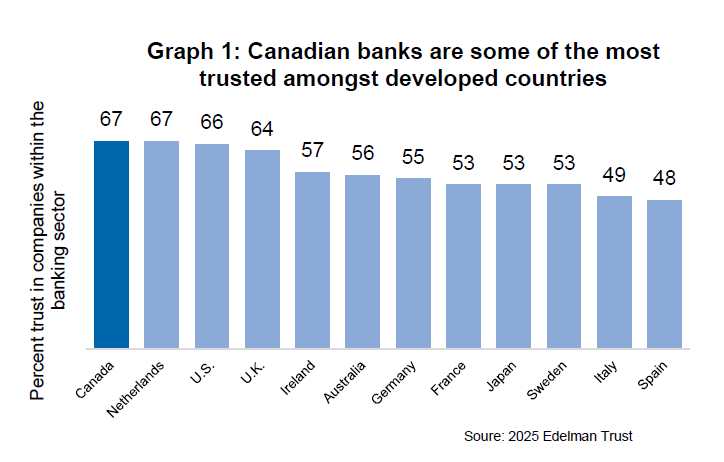
The financial sector is also influenced by regulatory initiatives that focus on consumer protection and market stability (e.g., AML, privacy rules, cybersecurity). Canadian banks comply with these public policy initiatives while providing competitive services and maintaining some of the highest levels of consumer trust among developed countries (Graph 1).
Recommendation 1: A coordinated approach to combat financial crimes
Financial crimes, such as scams, identity theft, and account takeovers, continue to threaten Canadians, with some schemes being linked to organized criminal networks beyond Canada’s borders. Reported fraud incidents have doubled over the past decade and cost Canadians more than $645 million in 2024 alone. Given that financial crimes are significantly underreported, total annual losses are estimated to exceed $12 billion.12 Throughout 2024 in Manitoba alone, based on reports, financial crimes resulted in reported losses over $41 million. However, actual losses are likely much higher due to underreporting by victims.
In response, the CBA is collaborating with some 50 organizations across public and private sectors (government regulators, financial institutions, telecommunications companies, law enforcement and digital platforms) in a Canadian Anti‑Scam Coalition (CASC). CASC is dedicated to protecting Canadians through coordinated education, awareness, and prevention initiatives that address scams in all their forms. And, while prevention and education are essential, effective enforcement and prosecution are equally critical to ensure criminals are held accountable under the Criminal Code of Canada, preventing further victimization.
Protecting Canadians against financial crimes requires a coordinated and proactive strategy that spans the fraud lifecycle, from prevention and detection across all sectors to enforcement and prosecution. This is why we support the federal government’s Budget 2025 announcement to develop a whole‑of‑government National Anti‑Fraud Strategy. This strategy aligns well to the work of CASC and should bring together financial institutions, technology, and telecommunication companies to develop a cross‑sectoral approach to protect Canadians from evolving and highly complex fraud schemes. An effective National Anti‑Fraud Strategy should integrate public‑private collaboration, reinforce enforcement and prosecution capacity, and empower Manitobans through education. Manitoba’s approach to anti‑fraud should embody elements in the upcoming National Anti‑Fraud Strategy, including coordination with all sectors involved in the fraud lifecycle.
Recommendation: Ensure the National Anti‑Fraud Strategy addresses key requirements to combat financial crimes provincially and federally, including adequate resources to hold criminals accountable under the Criminal Code of Canada. Specifically, the CBA supports the following measures:
- Centralizing financial crimes reporting flows between the Canadian Anti‑Fraud Centre (CAFC) and Manitoba police agencies to better provide line of sight to authorities to track and mitigate these crimes
- Ensuring sufficient training, funding, and dedicated resources for law enforcement and prosecutors to respond to the rising volume and sophistication of financial crime
- Expanding public education initiatives to equip Manitobans with the knowledge and tools they need to protect themselves against financial crime and scams
- Taking a multi‑sector approach to combatting scams, including coordinating with telecommunications and online platforms
Recommendation 2: A harmonised anti‑money laundering and anti‑terrorist financing regime
The Proceeds of Crime (Money Laundering) and Terrorist Financing Act (PCMLTFA) must continue to serve as the cornerstone in Canada’s fight against money laundering (ML) and terrorist financing (TF). While the CBA may support certain changes to the PCMLTFA, we caution against introducing new provincial requirements, reporting or otherwise, on federally regulated entities. Any fragmentation of the national regime could inadvertently:
- Empower bad actors by creating pockets of legislative arbitrage if federal and provincial requirements are misaligned
- Undermine the federal government’s ongoing and important national policy efforts
- Complicate coordination among expanding set of authorities as ML and TF risks evolve, and
- Potentially exacerbate concerns with high‑level, low impact reporting
Rather than adding new layers of regulations to an already comprehensive federal framework, the CBA urges the Government of Manitoba to support existing anti‑money laundering (AML)/anti‑terrorist financing (ATF) tools and invest in law enforcement to strengthen the fight against ML and TF by:
- Working with the federal government to continue to expand the interoperability of beneficial ownership registries in Canada to create a one‑stop shop and continue to enhance the transparency of beneficial ownership by expanding registries to include other entities (e.g., partnerships, trusts, and associations) from across Canada
- Investing in law enforcement to support its investigation and prosecution of ML and TF cases and enhance coordination with relevant federal authorities, including the Financial Crimes Agency being developed by the federal government
Recommendation: Collaborate with the federal government to strengthen Canada’s commitment to corporate beneficial ownership transparency, in addition to investment in relevant authorities to support ML and TF investigations. In particular, we urge investments in Manitoba’s enforcement and prosecution capacity, while harmonizing existing tools with federal measures. A harmonized approach will ensure effectiveness by avoiding legislative arbitrage and reduce compliance duplication across jurisdictions.
Recommendation 3: Make financial regulation more efficient and consistent across Canada
Canadians continue to adopt new payment methods offered by non‑traditional payment service providers (PSPs), including Big Tech. However, these PSPs are largely un- or under‑regulated. Moreover, new payment forms such as stablecoins are emerging with a new draft legislative framework at the federal level.
Globally, G20 member countries and the OECD have recognized the risks associated with entities that engage in bank‑like activities without bank‑like regulation. Failure to address the risks associated with these entities could create stability concerns and erode trust in the financial system. Financial services and products raise public policy issues that must be addressed by governments.
As an example, while the Retail Payment Activities Act establishes a federal framework for PSPs to address certain financial and security risks, it does not impose the full range of protections for consumers that would be applied to banks and is silent on market conduct. Given the Bank of Canada’s mandated oversight of nearly 3,000 PSPs, consumer usage is likely to increase and the absence of market conduct regulation is a significant gap in ensuring fair outcomes and protection for Canadians.14
Manitobans should benefit from a secure, reliable, and consistent financial system regardless of the nature of the financial payments provider or geographical residence. Therefore, it is important that un- or under‑regulated players do not introduce risk into the financial system. The financial services regulatory framework, including market conduct, should adopt the principle of "same activity, same risk, same regulation" and should continue to evolve to reflect changes in technology.
Recommendation: Support the creation of a financial regulation framework for un- or under‑regulated payments service providers (such as e‑commerce platforms and similar entities), rooted in the strong system that presently governs banks, by working with the federal and other provincial governments to establish a nationwide market conduct framework that provides consistent protections to all Canadians regardless of location.
Recommendation 4: Strengthen public safety and community well‑being
Emerging risks to automated teller machines (ATMs) from heavy construction equipment misuse
Across Canada, ATM attacks involving construction equipment are rising sharply: from one incident in 2023 to six incidents in 2024 to ten in 2025. In 2025, such attacks accounted for 28 percent of all ATM attacks.15 This trend is highly concerning due to the scale of losses and broader impact on local businesses and communities. Beyond the direct financial impact and the costs of repair and replacement of damaged ATMs, temporary or prolonged branch closures reduce access to essential banking services. These disruptions are especially harmful in rural or underserved areas, where alternative banking options are limited.
A contributing factor to such attacks is the use of universal keys in many types of construction machinery. These keys are easily obtainable and interchangeable across brands and models, creating a substantial security vulnerability. Bad actors, including organized criminal networks, are becoming increasingly sophisticated, often conducting reconnaissance and likely obtaining master keys in advance. To mitigate these risks, manufacturers and contractors should adopt unique, machine‑specific access systems to ensure that only authorized personnel can operate equipment. Some heavy construction equipment is also equipped with ignition kill switches or immobilizers that require a personal identification number (PIN) for bypass. To reduce the risk of PIN compromise and subsequent circumvention of these security controls, we recommend increasing the frequency of the PIN lifecycle management, including the issuance, updating, and retirement of PINs.
Additionally, notices of approved construction site locations would enable ATM operators to apply risk‑based security measures to mitigate the opportunities of theft with heavy construction equipment. Information sharing between stakeholders, including governments, CBA and private sector stakeholders would assist in the implementation of risk‑based security measures.
Community safety challenges
In 2024, Manitoba’s crime rate per 100,000 was 74 percent above the national average.17 In many parts of Canada, rising crime and violence continue to affect communities, creating heightened safety concerns for commuters to workplaces, forcing businesses closures, reducing family‑supporting jobs, and growing pressures on mental health and social support programs.18
A comprehensive, cross-jurisdictional approach is needed to address the interconnected challenges of mental health, addiction, homelessness, and public safety that impact banks and surrounding communities. Temporary measures such as removing unhoused individuals from ATM vestibules or businesses (by security guard services or law enforcement) displaces the individuals from one location to another, is not sustainable long-term, and fail to address root causes. To that end, loitering remains a high concern for banks, accounting for 66 percent of all fiscal 2025 physical security incidents in Manitoba alone.19 Strengthening mental‑health and addiction supports, expanding crisis‑response teams like Winnipeg‘s Mobile Crisis Service offered by the Winnipeg Regional Health Authority (WRHA) and investing in permanent housing and economic-stability initiatives are also essential to reducing disruptive behaviour, enhancing staff and customer safety, and supporting healthier, more resilient communities. Crisis response teams such as Winnipeg’s Mobile Crisis Service consist of health care professionals working alongside specially trained police officers, help and de‑escalate volatile situations, and connect individuals to follow‑up care and community programs.20
We request that the Government of Manitoba provide a comprehensive listing of all crisis‑response teams operating across the province. Centralizing this information would significantly reduce the administrative burden currently placed on financial institutions, which are otherwise required to compile this data independently across jurisdictions.
The CBA is active in finding solutions to these challenges across the country. For example, Downtown Winnipeg BIZ is a non‑for‑profit organization that works to foster a prosperous and vibrant downtown area. Organizations such as Downtown Winnipeg BIZ address a range of issues, including safety and security, and to support unhoused or street-involved individuals. We recommend that other municipalities launch similar initiatives to help energize and stimulate local communities across Manitoba.
Recommendation: Strengthen public safety and community well‑being by:
- Introducing legislation or industry regulations to phase out the use of universal master keys in heavy construction equipment and implementing a regular PIN management regiment
- Facilitating information sharing of construction site locations with various stakeholders to allow ATM operators to implement risk‑based security measures
- Implementing innovative and comprehensive solutions that address public safety challenges, while improving community vitality and economic growth
- Urgently increasing funding for community vibrancy projects, addiction recovery services, and expanded Police and Crisis Teams
- Enhancing community services for unhoused individuals, recognizing that this continues to be a significant challenge
- Launching local coalition efforts to revitalize heavily impacted cities and regions
- Providing a comprehensive listing of all crisis response teams operating across the province
Recommendation 5: Enhance labour mobility by harmonizing any proposed Financial Planner and Advisor (FP/FA) credentialling requirements
As tariffs increase both the cost and uncertainty of doing business with the U.S., federal and provincial governments are increasingly focused on eliminating internal trade barriers. The CBA is encouraged by this momentum, as jurisdictional differences in policies, including licensing, standards, procurement, and service regulation, create barriers with significant economic consequences. These barriers affect productivity, competitiveness, and overall economic resilience.
The International Monetary Fund (IMF) estimates that policy-related barriers within Canada are equivalent, on average annually, to a nine percent tariff nationally, with the costs largely concentrated in services sector and unevenly distributed across regions. Ultimately, such frictions and inefficiencies increase costs, reduce consumer choice, and undermine productivity, competitiveness, and economic resilience.
The IMF also recognizes that finance, transportation, and telecommunications are critical enablers of economy-wide efficiency, innovation, and competition. Accordingly, the CBA supports the elimination of duplicative, overlapping, or fragmented requirements across federal, provincial, and territorial financial and adjacent regulatory regimes. Doing so would make it easier to start and expand businesses, improve labour mobility, and support investment.
While Canada’s banks operate within a federal regulatory framework, the broader financial services sector, including banks, continue to face financial and adjacent regulations that impede seamless, efficient operations across the country. For example, banks collectively employ tens of thousands of FPs and FAs nationwide, including a significant number in Manitoba, and invest substantial resources to comply with varying provincial title protection requirements. Banks have also been engaged in public consultations on these title requirements Manitoba as well as Saskatchewan, New Brunswick, and Ontario.
To the greatest extent possible, and in alignment with Canada’s broader objective of reducing interprovincial trade barriers, approaches to FP and FA title protection should be harmonized across provinces and territories. A harmonized framework achieves several key benefits, including:
- Preventing an "advice gap": Setting credentialling standards substantially higher than those already established in Ontario and New Brunswick may reduce the number of qualified FAs/FPs, inadvertently limiting consumer access to much needed advice on financial products
- Preventing consumer confusion: Consistent standards across Canada helps ensure that consumers can trust the qualifications of financial professionals, regardless of where they are located
- Facilitating professional mobility: A harmonized regime will allow financial professionals to move seamlessly between provinces and territories, supporting financial firms and credentialling bodies that operate nationally, while ensuring a consistent level of service for consumers across Canada
- Reducing burden: Avoiding duplicative regulation will minimize unnecessary compliance costs for market participants
Recommendation: Harmonize any proposed Financial Planner/Financial Advisor (FP/FA) title protection credentialling regime developed in Manitoba with Ontario and New Brunswick’s existing frameworks. This should include recognizing the regulatory oversight of individuals registered as representatives or approved persons of the Canadian Investment Industry Regulatory Organization (CIRO) and the provincial and territorial securities commissions.
Recommendation 6: National collaboration to streamline investment account switching for all Canadians
Provincial governments play an important role in ensuring Canadians benefit from a seamless, secure, and efficient investment and registered account switching process. The federal government’s Budget 2025 initiative to prohibit fees on transfers across account types and institutions, require timely transfers of funds, and mandate clear presentation about the transfer process is also an opportunity to modernize the account transfer system.21 This includes standardizing transfer procedures, improving security, and harmonizing regulations across the entire account transfer ecosystem that extends beyond banks22 to ultimately provide a more consistent experience for investors.
Currently, regulations and procedures vary across the account transfer system, which includes financial institutions under provincial jurisdiction (e.g. investment dealers, mutual fund dealers, credit unions and caisses populaires, trust companies, insurance companies). A lack of a coordinated and harmonized approach risks creating a fragmented, two‑tiered regulatory framework that undermines competition, confuses clients, and leads to a patchwork of transfer tools, standards and processes.
The Manitoba Financial Services Agency should coordinate with self‑regulatory organizations such as the Canadian Investment Regulatory Organization (CIRO) and the federal government to ensure that any account transfer reforms are designed and implemented in an aligned and harmonized manner. Such collaboration would ensure that prospective regulations are implemented consistently across account types and financial institutions.
The CBA believes that such coordination should produce the following outcomes, all of which will benefit Canadians:
- Harmonized regulations that apply to all institutions in the account transfer ecosystem (banks, investment dealers, mutual fund dealers, credit unions and caisses populaires, trust companies, insurance companies, etc.)
- An industry‑wide standard for account transfer procedures and timelines – including a defined 10‑clearing‑day settlement period for account transfers (with exemptions during peak season and for complex cases) and explicit obligations for both receiving and delivering firms when impediments arise
- Use of automated transfer services (ATON/Fundserv/CANNEX) for eligible assets and electronic communications where available
- Industry‑wide adoption of a modernized and interoperable electronic/automated account transfer solution (building on ATON/Fundserv/CANNEX, etc.) that eliminates the use of manual processes (paper/fax/cheques) and incorporates strong authentication and anti‑fraud controls
Recommendation: Collaborate with the federal government by having the Manitoba Financial Services Agency coordinate with self-regulatory organizations such as the Canadian Investment Regulatory Organization (CIRO) to:
- Support harmonized regulations across all institutions offering investment and registered accounts
- Modernize account transfer infrastructure
- Establish standardized procedures and timelines
Recommendation 7: Reform the tax system to work for Canadians
Canadians’ standard of living, as measured by real GDP per person, was lower in 2024 than in 2014. Canada risks continued deterioration in living standards without improvement to its low labour productivity, ultimately resulting in wage stagnation, constraints to governments’ public services, increased production costs, and reduced competitiveness globally.
Canada’s productivity has declined significantly over time, falling from sixth place among Organisation for Economic Co‑operation and Development (OECD) countries in 1970 to 18th in 2022 and ranks second last among G7 countries.23 In relation to our largest trading partner, productivity in Canada is approximately 30 percent lower than in the U.S., comparable to levels seen in lower‑income states rather than in innovation leaders like California or New York.24
Furthermore, since the last comprehensive review nearly 60 years ago, Canada’s tax system has evolved without a consistent focus on foundational tax policy principles that underpin domestic and foreign investment, economic growth, and innovation. The International Monetary Fund (IMF), the OECD, and others have urged Canada to implement growth‑oriented tax policies. This is unsurprising given Canada’s loss of its business tax advantage internationally: it now ranks 27th of 38 OECD countries in corporate tax rates and has the third highest combined corporate and personal tax rates in the OECD.25
Targeted taxes on the financial services sector have further undermined economic growth and productivity by limiting banks’ capital available for Canadian businesses, reducing Canadians’ ability to save and invest, and dampening foreign investment. Other countries recognize the negative effects of sector-‑specific taxes with Australia’s Government Productivity Commission concluding that industry levies must be avoided to establish or maintain sound foundations for productivity growth.26
Canada’s targeted taxes include:
- Capital taxes of over $70 million imposed on banks in Manitoba ultimately reduces retained earnings and penalizes banks for holding prudential and regulated buffers to support lending and absorb credit risks during economic downturns
- Removal of the Dividend Received Deduction, impacting over 3 million Canadians holding market‑linked GICs and notes, often middle‑class households close to retirement who seek stable returns and downside protection
- The 2022 Financial Institutions (FI) Tax and the Canada Recovery Dividend (CRD) curtailed credit capacity to businesses and consumers as every dollar reduction in retained earnings translates into over $7.50 of foregone new credit capacity. These taxes also led to a divestment of $11.6 billion in Canadian bank equity by foreign investors in 2023
- Retroactive sales taxes on payment clearing services undermine the tax system’s principles of predictability, certainty, fairness, and investor confidence
Canada’s persistent productivity challenges, combined with heightened uncertainty arising from trade and tax policies in the U.S., underscore the need for comprehensive tax reform more than ever. Strengthening Canada’s resilience to external economic shocks will require a tax system that is modern, efficient, and competitive. We were encouraged by the Prime Minister’s campaign promise, which included a commitment to review Canada’s corporate tax system, guided by the principles of fairness, transparency, simplicity, sustainability, and competitiveness and encourage provinces to support such a review.
Recommendation: Support the federal government’s electoral commitment to conduct a comprehensive review of the corporate tax system. The review should aim to improve nationwide productivity, job creation, and economy by:
- Removing the province’s Corporation Capital Tax on financial institutions to promote economic growth
- Ensuring the tax system is anchored on the principles of tax efficiency, neutrality, certainty, and competitiveness
- Encouraging the federal government to end sector-specific tax measures by reinstating the Dividend Received Deduction for financial institutions and phasing out the Financial Institutions Tax
- Prohibiting the use of retroactive taxation that creates uncertainty for businesses and investors
- Publicly support lowering Canada’s statutory and effective corporate tax rates, and the combined rate for investors, to rank within the lowest third in the OECD by 2030 and annually track progress against that objective to encourage international and domestic investment
Recommendation 8: Enable federal options for credit unions
In addition to more than 70 banks, three federal credit unions are currently licensed under the federal Bank Act to operate across Canada, affording them the ability to compete by scaling and making necessary investments in technology, talent, and risk management. However, most credit unions operate under provincial oversight in Manitoba, 17 credit unions service more than 741,000 customers, hold nearly $46 billion in assets and nearly $41 billion in deposits.27 Migrating to a federal license enables credit unions to carry on business outside or to merge with (or purchase assets from) credit unions outside their home province, which enables economies of scale and diversifies risks across markets.
While policymakers acknowledge that scale enhances resilience, builds internal capacity (technical, operational, and strategic), and improves risk management, the process for federal credit union mergers, amalgamations or asset acquisitions with provincially regulated entities is long and cumbersome.28 Transactions involving federal and provincial credit unions require approval from the Minister of Finance, OSFI, the provincial regulator, deposit insurers, and the Competition Bureau.29 In Budget 2025, the federal government has acknowledged the need for support for federal credit unions’ growth, via amalgamation or asset acquisitions, and to make it easier for credit unions to enter the federal framework.
Most provincial legislation is silent on a credit union’s continuance under the Bank Act, an option for credit unions to operate under the national standard or amalgamate with an existing federal credit union.30 The limited number of transitions to date highlights persistent internal regulatory barriers and greater transition flexibility is needed to allow credit unions to scale and compete across provinces. Therefore, the province should ensure a smooth and efficient process for provincial credit unions to transition to the federal level as stand‑alone or amalgamated entities and ensure requirements (including approvals) be proportionate to the transaction and provide guidance that facilitates credit unions’ continuance under the federal Bank Act following an amalgamation or asset transaction between federal and provincial credit unions.
One of the benefits of the federal regulatory framework is transparency: federally regulated institutions must publish monthly and quarterly financial disclosures that are published on the Office of the Superintendent of Financial Institutions (OSFI) website. Most provincial credit unions currently post annual financial statements on their individual sites. More frequent, standardized disclosures through a centralized portal would strengthen transparency of the credit union system’s financial state, helping inform depositors and borrowers when making financial decisions. Such transparency will improve visibility and understanding of key risks, promote public confidence and stability in Manitoba’s provincial credit union system.
Lastly, to ensure Canada’s financial system continues to remain one of the safest and reputable in the world, Manitoba’s unlimited deposit guarantee should be re-examined to align with national and international best practices.
Recommendation: Provide policy and regulatory support to help provincially regulated credit unions that choose to transition to the federal credit union framework as well as amalgamations and asset transactions between federal and provincial credit unions, increase financial transparency in the provincial credit union system, and align the provincial credit unions’ unlimited deposit guarantees to international and national best practices.
Conclusion
The CBA appreciates the opportunity to contribute to the province’s upcoming Budget. Our recommendations are designed to help shape Canada’s, and Manitoba’s, future by fostering investment and innovation, strengthening communities across the province, and enhancing the resilience of our country’s economy. Critically, we seek to ensure that Manitobans, indeed all Canadians, have the opportunity to thrive. We welcome the opportunity to discuss our recommendations in greater detail and to explore efforts to collaboratively deliver benefits for Manitobans.
1 2024 banking contributions provided by CBA, workforce composition based on 2023 data, Statscan.
2 Mortgage lending statistics provided by Bank of Canada
3 Lending statistics provided by CBA
4 ISED, Credit Conditions Survey, 2010 to 2024. The average annual approval rate over this period was 88%.
5 CBA estimates with OSFI financial data, annual financial disclosures, Credit Union Central of Manitoba.
6 CMHC National Housing Act Approved Lenders.
7 Tracxn, FinTech Startups in Canada, as of October 8, 2025
8 Calculated from Payments Canada, Payment Methods and Trends Report 2024. Includes debit card, credit card and prepaid card, by value.
9 Calculated by CBA.
10 CBA calculations and Bennett Jones, Economic Outlook 2025, Safeguarding a Vital Relationship and Investing in a More Productive Economy. While the Finance and Insurance produced $93 in real GDP per hour worked, banking and other depository credit intermediation produced $113.40 in real GDP per hour worked.
11 Conference Board of Canada, Funding the Future: The Economic Impact of Canada’s Investment Funds Industry, September 2024, Blended MER including ETF calculated using market share data on p. 5.
12 Competition Bureau of Canada, Fraud Prevention Month to focus on impersonation fraud, one of the fastest growing forms of fraud, February 2025
13 CAFC 2024 Annual Statistical Report
14 Bank of Canada, Laying bare the evolution of payments in Canada, May 2024
15Figures are provided for a calendar year, January to December.
16 CBC, Easy to get heavy equipment keys, says operator after back‑to‑back robberies, January 2019
17 Statistics Canada, Incident-based crime statistics, by detailed violations, Canada, provinces, territories, Census Metropolitan Areas and Canadian Forces Military Police, September 2025.
18 Saskatoon credit union branch to close due to 'increased threat' to safety, CTV News Saskatoon, November 2023.
19 Fiscal 2025 figures encompass incidents occurring throughout November 2024 to October 2025
20 Mobile Crisis Service - WRHA Professionals
21 Budget 2025, p. 117
22 Includes investment dealers, mutual fund dealers, credit unions, trust companies, insurance companies, etc.
23 OECD, OECD Compendium of productivity indicators 2023, February 2023
24 RBC Thought Leadership, Canada’s growth challenge: Why the economy is stuck in neutral, June 2024
25 OECD, Corporate income tax statutory and targeted small business rates, Combined (corporate and shareholder) statutory tax rates on dividend income, 2024 and Effective tax rates, 2023. (OECD Data Explorer)
26 Australian Government Productivity Commission, Towards Levyathan? Industry levies in Australia Research paper, December 2023
27 Credit Union Central of Manitoba, Annual Report 2024, December 2024.
28 BCFSA, Cooperative Finance at a crossroads: Strengthening system design for what’s ahead, July 2025
29 CCUA, Stronger Together, Sooner: A Roadmap for Faster and Fairer Credit Union Merger, Reviews, August 2025
30 Currently, Alberta and New Brunswick have legislation that explicitly contemplates the amalgamation of a provincially regulated credit union with a federally regulated credit union under federal continuance