Article
The CBA appreciates the opportunity to help shape Saskatchewan’s future by contributing to the Ministry of Finance’s upcoming Budget. Representing more than 60 domestic and foreign banks, we advocate for public policies that support a sound and secure banking system, while fostering economic growth and prosperity for all Canadians. We are pleased to present our industry recommendations, followed by additional detail and supporting rationale for each recommendation.
Recommendation 1 – A need for a coordinated nationwide approach to combat financial crimes
To strengthen Saskatchewan’s response to fraud and financial crime, the CBA supports the following measures:
- Develop a Saskatchewan anti-fraud framework that aligns with the objectives of the National Anti‑Fraud Strategy (NAFS)
- Invest in enforcement and prosecution capacity for serious and complex financial crime, recognizing the growing role of organized criminal networks in fraud and scams
- Explore the creation of a centralized specialized financial crime model, similar to Ontario’s Serious Fraud Office (SFO), to improve coordination, expertise, and enforcement outcomes
Recommendation 2 - Improve enforcement effectiveness for money laundering and terrorist financing offences
Rather than adding new layers of provincial requirements to an already comprehensive federal framework, the CBA urges the Government of Saskatchewan to support and reinforce existing AML/ATF tools and initiatives by:
- Working with the federal government to continue to expand the transparency of beneficial ownership in Canada through a one‑stop‑shop, publicly accessible beneficial ownership registry that reflects, through aligned data points, the beneficial ownership information of corporations and other entities (e.g., partnership, trusts, and associations) form across Canada
- Investing resources and providing training to law enforcement to support its investigation and prosecution of high‑risk money laundering and terrorist financing cases and enhance coordination with relevant federal authorities, including the recently launched Financial Crime Agency (FCA)
Recommendation 3 – Make financial regulation more efficient and consistent across Canada
Support the creation of a financial regulation framework for un- or under‑regulated payments service providers (such as e‑commerce platforms and similar entities), rooted in the strong system that presently governs banks, by working with the federal and other provincial governments to establish a nationwide market conduct framework that provides consistent protections to all Canadians regardless of location
Recommendation 4 – Harmonize Financial Planner and Advisor (FP/FA) credentialling to support labour mobility
Harmonize Saskatchewan’s Financial Advisor/Financial Planner (FA/FP) title protection credentialling regime with Ontario and New Brunswick’s existing frameworks. This should include recognizing the regulatory oversight of individuals registered as representatives or approved persons of the Canadian Investment Regulatory Organization (CIRO) and the provincial and territorial securities commissions.
Recommendation 5 – Collaborate nationally to streamline investment and registered account switching for all Canadians
Collaborate with the federal government by having Saskatchewan’s Financial and Consumer Affairs Authority coordinate with self‑regulatory organizations such as the Canadian Investment Regulatory Organization (CIRO) to:
- Support harmonized regulations across all institutions offering investment and registered accounts
- Modernize account transfer infrastructure
- Establish standardized procedures and timelines
Recommendation 6 – Institute cost‑benefit analyses into the financial regulatory assessment process
Require Saskatchewan’s financial regulators implement cost‑benefit analyses that specifically incorporates growth and competitiveness considerations into the regulatory assessment process.
Recommendation 7 – Strengthen public safety and community well‑being by:
- Introducing legislation or industry regulations to phase out the use of universal master keys in heavy construction equipment and implementing a regular PIN management regiment
- Facilitating information sharing of construction site locations with various stakeholders to allow ATM operators to implement risk‑based security measures
- Supporting community safety initiatives that address crime and related community safety challenges while improving community vitality, including increased funding for community vibrancy projects and services for unhoused individuals
- Ensuring that crisis response teams and first responders have appropriate funding, training, and tools to recognize and effectively de‑escalate mental health or addiction‑related crises to improve outcomes for vulnerable individuals, thereby reducing reliance on arrest‑based responses which preserves justice‑system capacity for other public‑safety priorities, including complex financial crime cases
- Strengthening communities through local partnerships utilizing coalition‑based approaches to revitalize heavily impacted communities
- Providing a comprehensive listing of all crisis response teams operating across the province
Recommendation 8 – Support a comprehensive review of Canada’s tax system
Support the federal government’s electoral commitment to conduct a comprehensive review of the corporate tax system. The review should aim to improve nationwide productivity, job creation, and economic growth by:
- Removing the province’s Corporate Capital Tax on financial institutions to promote economic growth
- Ensuring the tax system is anchored on the principles of tax efficiency, neutrality, certainty, and competitiveness
- Encouraging the federal government to end sector‑specific tax measures by reinstating the Dividend Received Deduction for financial institutions and phasing out the Financial Institutions Tax
- Prohibiting the use of retroactive taxation that creates uncertainty for businesses and investors
- Publicly support lowering Canada’s statutory and effective corporate tax rates, and the combined rate for investors, to rank within the lowest third in the OECD by 2030 and annually track progress against that objective to encourage international and domestic investment
Recommendation 9 – Promote a more integrated national market by reducing internal trade barriers in financial services
In alignment with the objectives of the Canada Free Trade Agreement, reduce internal trade barriers for financial services by:
- Coordinating provincial approaches to over‑the‑counter (OTC) derivatives participation fees to prevent duplicative charges by multiple provincial securities regulators for the same transactions, preserve market liquidity, and ensure that fees in Canada are proportionate to the size of its OTC derivatives market relative to its international peers
Recommendation 10 – Apply a digital‑first approach to government operations and financial sector regulation
Given shifting consumer expectations, continued digital transformation, government modernization initiatives, the risks of postal disruptions, and the phasing out of daily door‑to‑door mail delivery, as well as the significant productivity, consumer, security, and environmental benefits, the CBA recommends adopting a digital‑first approach to financial sector regulation and service delivery by increasing the use of direct deposits and phasing out government cheque payments, including tax refunds, to improve efficiency, reduce taxpayer costs, and mitigate risks of scams.
Introduction: Banks’ support for Saskatchewan’s economy
Beyond serving as a cornerstone of Canada’s strong and stable financial system, banks help Saskatchewanians achieve their financial goals -whether purchasing a home, starting a business, saving for the future, or navigating periods of financial uncertainty. The following provides an overview of the banking sector’s contributions to Saskatchewan’s economy as well as the competitive intensity in the financial services market. For more information, please visit cba.ca.
Banks played a vital role in Saskatchewan’s prosperity by:1
- Contributing close to $1.5 billion (about 1.7%) of GDP to Saskatchewan’s economy
- Paying close to $300 million in taxes to all levels of government across Saskatchewan and generating more than $31 billion in dividend income for Canadian seniors, families, pensions, charities, and endowments
- Employing about 3,700 people in an inclusive and equitable workforce, with women representing about 63% and self‑identified visible minorities comprising about 38%
Banks helped Saskatchewanians:
- Purchase homes, with more than $26 billion in residential mortgages outstanding2
- Start and grow businesses, with nearly $77 billion in total business credit authorized and authorized approximately $20 billion in credit for small and medium‑sized enterprises3
- Facilitate access to financing, approving more than 9 in 10 small business debt financing requests annually since 20104
Banks partnered with agricultural clients, delivering tailored solutions to meet their unique needs:
- Authorized close to $22 billion in credit across Saskatchewan and Manitoba
- Canadian banks have a long and proud history of working with farmers, from extreme weather events, animal viruses to the COVID‑19 pandemic and rail strikes
Banks compete aggressively with one another
Canada’s financial services sector is highly competitive, supported by technological innovation, diverse market players, and evolving consumer and business preferences. Technological advancements have lowered barriers to entry and enabled competitors to scale more quickly, improving accessibility, customer experience, and service delivery while increasing contestability across the market.
Canada’s largest banks remain a cornerstone of the financial system and compete vigorously with one another and broad and diverse range of players. The federally regulated and licensed institutions competing across the country include six domestic systematically important banks (DSIBs), 24 small and mid-sized domestic banks (SMSBs), 43 foreign bank subsidiaries or branches, and four federally regulated credit unions. We welcome the action taken by the Government of Saskatchewan to assist with this competition by reducing regulatory barriers that previously limited the ability of credit unions to scale by transitioning to the federal framework and merging with other credit unions.
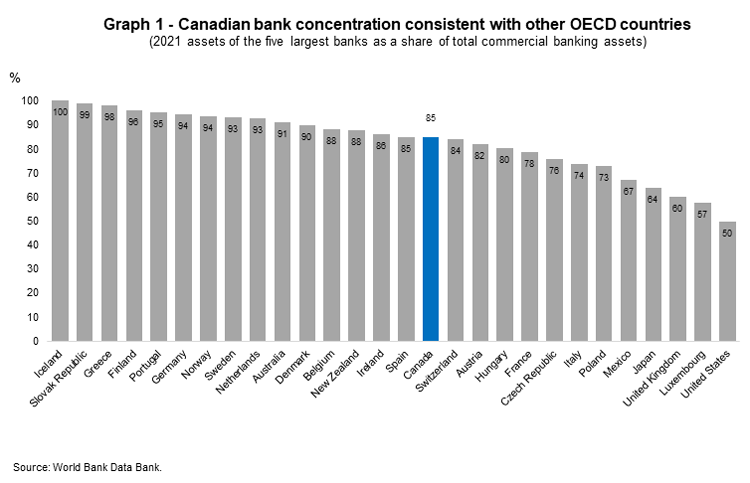
The structure of Canada’s banking sector is also broadly comparable with that of other peer jurisdictions. World Bank data places Canada mid‑range for the asset concentration of its five largest banks, with several peers, including Germany, Australia, and New Zealand, having higher levels of concentration (Graph 1). Importantly, the OECD cautions that concentration should not be equated with market power or competitive intensity, which are more directly relevant to consumers.
Competition extends well beyond federally regulated deposit-taking institutions (DTIs)
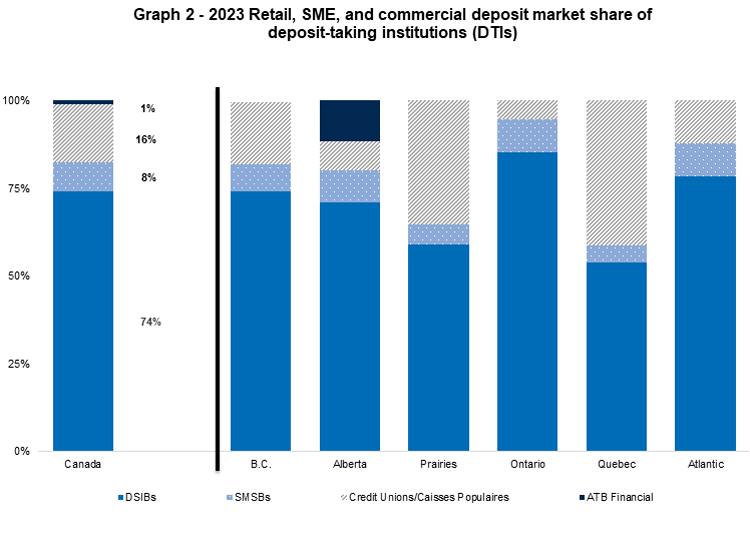
Concentration measures such as those presented in Graph 1 do not fully capture the competitive dynamics of retail banking.5 Consumer deposit shares can provide a more meaningful measure of competition at the local level, as they reflect the range of institutions available to consumers for everyday banking needs.
The deposit-share measure captures both federally and provincially regulated DTIs, including the more than 30 provincially regulated credit unions in Saskatchewan. Collectively, these DTIs operate more than 400 branches in Saskatchewan, with banks accounting for nearly half of these locations.
When this broader competitive landscape is considered, the concentration of the retail banking market changes meaningfully, particularly across the Prairies (Graph 2). Assessing competition requires looking beyond the federally regulated DTIs to capture a full range of regulated institutions competing for Saskatchewan residents’ and business’ deposits.
Banks also compete with a wide array of other lenders and financial service providers, including government‑backed institutions (e.g., BDC, FCC), trust and loan companies, machinery and equipment financing companies, monoline and specialty lenders, mortgage investment corporations, private lenders, and fintech lenders. These competitors do not collect deposits, and instead rely on vendors, dealers, finance brokers, captive finance arms, and direct sales teams to originate their lending activities. While these non‑deposit taking lenders operate without the same prudential requirements as regulated DTIs, they demonstrate that competition in Canada’s financial services sector extends beyond prudentially regulated DTIs.
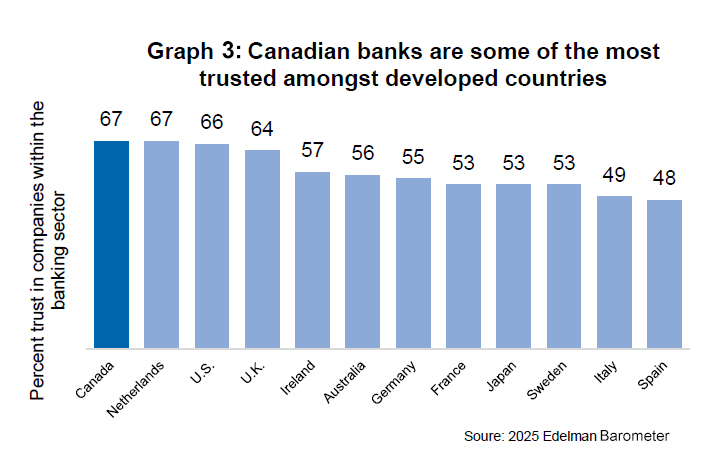
The financial sector is also influenced by regulatory initiatives focused on consumer protection and market stability (e.g., AML, privacy rules, cybersecurity). Canadian banks comply with these public policy initiatives while providing competitive services and maintaining high levels of consumer trust among developed countries (Graph 3).
Banking services represent a small and declining share of household spending
In a world where prices for most goods and services have been rising, the share of household spending devoted to banking services has declined. Between 2013 and 2023, the average Saskatchewanian’s household spending on service charges for banks and other financial institutions fell by 14 per cent, accounting for just 20 cents of every $100 of household spending in 2023 (Table 1). This trend is consistent with the benefits consumers can derive from continued innovation and competition in the financial services sectors.
Table 1: Select household spending and CPI (Saskatchewan)
| |
2013 |
2023 |
Change |
| Total household expenditure |
79,370 |
94,005 |
18% |
| Shelter |
14,779 |
19,809 |
34% |
| Income taxes |
14,049 |
15,962 |
14% |
| Food |
7,332 |
12,707 |
73% |
| Personal insurance and pension contributions |
4,928 |
6,241 |
27% |
| Communications |
2,133 |
3,299 |
55% |
| Health care |
1,965 |
3,277 |
67% |
| Service charges from banks and other financial institutions* |
215 |
185 |
-14% |
| CPI |
122.7 |
158.3 |
29% |
Source: Statistics Canada, Household spending, Canada, regions and provinces (Table: 11-10-0222-01) and CPI Table 18-10-0005-01, accessed 20260910
*Service charges for banks and other financial institutions include monthly bank charges, withdrawal fees, safety deposit box charges, annual fees for credit cards, fees related to annuity contracts and transfers of RRIFs
An example of consumers benefitting from this competitive intensity and innovation is the market for bank accounts. More than 40 banks offer 100 different bank account packages, providing Canadians a broad range of choices. In 2025, over a third (36 per cent) of Canadians said that they did not pay a monthly bank account fee, up from 27 per cent in 2017. A further 22 per cent of reported having their monthly few waived or refunded in 2025.6
Digital transformation is intensifying competition
The ongoing shift from physical to digital financial services has further increase competition. Fintech firms, including payment services providers, buy‑now‑pay‑later companies, digital currency exchanges, robo‑advisors, are rapidly expanding. According to Tracxn, more than 5,600 fintech startups are active in Canada.7
In addition, large multinational technology companies are well positioned to enter Canda’s financial services marketplace, leveraging strong brand recognition and vast access to consumer data to offer services nationwide without physical infrastructure. As a result, competitive intensity continues to increase, with new entrants relying on digital platforms and payment networks to reach consumers and businesses efficiently.
The following CBA recommendations support investment and innovation, strengthen financial protections in response to the rise in scams, and to reduce regulatory frictions towards the goal of strengthening Saskatchewan’s economic resilience, competitiveness, and long‑term prosperity.
Recommendation 1: A need for coordinated nationwide approach to combat financial crimes
Financial crimes, including scams, identity theft, and account takeovers, pose a growing threat to Canadians. Often linked to global organized criminal networks, financial crimes operate beyond national borders. Reported fraud incidents have doubled over the past decade, with losses exceeding $740 million in 2025. Due to significant underreporting, total annual losses are estimated to surpass $13 billion. These trends underscore the urgent need for stronger and more coordinated action to protect Saskatchewanians and ensure that Saskatchewan’s response keeps pace with evolving threats.
The CBA is collaborating with approximately 50 public and private sector partners, including regulators, financial institutions, telecommunications providers, law-enforcement, and digital platforms through the Canadian Anti‑Scam Coalition (CASC) to advance coordinated education, awareness, and prevention initiatives. While these efforts are essential, effective enforcement and prosecution are equally critical to deter criminal activity by holding criminals accountable under the Criminal Code of Canada and prevent further victimization. The CBA is actively engaging with the Department of Justice to advance these efforts as part of the broader implementation of the Financial Crimes Agency (FCA) and will continue to monitor the progress of this work as it evolves.
Fraud and scams are increasingly transnational, as recently noted by the United Nations Office on Drugs and Crime and the Financial Action Taskforce (FATF), and a growing global priority. Fraud has evolved into a global, organized, and technologically enabled criminal economy that no single jurisdiction, sector, or stakeholder can address alone. Protecting Canadians therefore requires a coordinated and proactive strategy that addresses the full fraud lifecycle, from prevention and detection across all sectors through to investigation, enforcement, and prosecution.
The CBA supports the federal government’s Budget 2025 commitment to develop a whole‑of‑government National Anti-fraud Strategy (NAFS). The NAFS provides an opportunity to build on the work of CASC and bring together financial institutions, technology companies, telecommunication providers, law enforcement, and government, to develop a coordinated, cross-sectoral approach to protect Canadians from evolving and highly complex fraud schemes. An effective NAFS should integrate public‑private collaboration, reinforce enforcement and prosecution capacity, and empower Saskatchewanians through education. Saskatchewan’s approach to anti-fraud should also embody elements of the upcoming NAFS, including coordination with all sectors involved in the combating fraud through its lifecycle.
To support these objectives and strengthen Saskatchewan’s capacity to respond to increasingly sophisticated fraud schemes, the province should also consider establishing a centralized, specialized model for investigating and prosecuting serious and complex financial crimes, similar to Ontario’s Serious Fraud Office (SFO). A specialized, province‑wide financial crime capability structure that integrates dedicated investigators, prosecutors, and specialized support personnel under a single mandate, enabling coordinated investigations and more effective prosecutions. Rather than operating in silos, law‑enforcement and prosecutorial resources work as one unit to combat serious and complex crimes. This model could enhance information sharing and coordination among key stakeholders, aligning with the objectives of the NAFS to promote a more coordinated and effective response to fraud.
Recommendation: To strengthen Saskatchewan’s response to fraud and financial crime, the CBA supports the following measures:
- Develop a Saskatchewan anti‑fraud framework that aligns with the objectives of the National Anti-fraud Strategy (NAFS)
- Invest in enforcement and prosecution capacity for serious and complex financial crime, recognizing the growing role of organized criminal networks in fraud and scams
- Explore the creation of a centralized specialized financial crime model, similar to Ontario’s Serious Fraud Office (SFO), to improve coordination, expertise, and enforcement outcomes
Recommendation 2: Improve enforcement effectiveness for money laundering and terrorist financing offences
Combatting money laundering (ML) and terrorist financing (TF) is critical to Canada’s safety, security and economic prosperity. As key participants within Canada’s AML/ATF regime, banks continually strengthen their internal programs, controls, and employee training to detect, deter, and disrupt increasingly sophisticated financial crimes, including proceeds from fentanyl trafficking and human trafficking. Banks also play a leadership role in public-private partnerships with FINTRAC, helping generate indicators that enhance suspicious transaction reporting across the financial system.
The Proceeds of Crime (Money Laundering) and Terrorist Financing Act (PCMLTFA) must continue to serve as the cornerstone in Canada’s fight against money laundering (ML) and terrorist financing (TF). While the CBA may support certain changes to the PCMLTFA, we caution against introducing new provincial requirements, reporting or otherwise, on federally regulated entities. Any fragmentation of the national regime could inadvertently:
- Empower bad actors by creating pockets of legislative arbitrage if federal and provincial requirements are misaligned
- Undermine the federal government’s ongoing and important national policy efforts
- Complicate coordination among expanding set of authorities as ML and TF risks evolve, and
- Potentially exacerbate concerns with high‑level, low impact reporting
The following actions will positively impact the fight against financial crime in Saskatchewan and are consistent with certain recommendations in the Financial Action Task Force’s mutual evaluation of Canada. Further, they will not trigger the foregoing unintended consequences.
Recommendation: Rather than adding new layers of provincial requirements to an already comprehensive federal framework, the CBA urges the Government of Saskatchewan to support and reinforce existing AML/ATF tools and initiatives by:
- Working with the federal government to continue to expand the transparency of beneficial ownership in Canada through a one‑stop‑shop, publicly accessible beneficial ownership registry that reflects, through aligned data points, the beneficial ownership information of corporations and other entities (e.g., partnership, trusts, and associations) form across Canada
- Investing resources and providing training to law enforcement to support its investigation and prosecution of high‑risk money laundering and terrorist financing cases and enhance coordination with relevant federal authorities, including the recently launched Financial Crime Agency (FCA)
Recommendation 3: Make financial regulation more efficient and consistent across Canada
Canadians continue to adopt new payment methods offered by non-traditional payment service providers (PSPs), including Big Tech. However, these PSPs are largely un- or under‑regulated.
Globally, G20 member countries and the OECD have recognized the risks associated with entities that engage in bank‑like activities without bank-like regulation. Failure to address the risks associated with these entities could create stability concerns and erode trust in the financial system. Financial services and products raise public policy issues that must be addressed by governments.
As an example, while the Retail Payment Activities Act establishes a federal framework for PSPs to address certain financial and security risks, it does not impose the full range of protections for consumers that would be applied to banks and is silent on market conduct. Given the Bank of Canada’s mandated oversight of nearly 3,000 PSPs, consumer usage is likely to increase and the absence of market conduct regulation is a significant gap in ensuring fair outcomes and protection for Canadians.
Saskatchewanians should benefit from a secure, reliable, and consistent financial system regardless of the nature of the financial payments provider or geographical residence. Therefore, it is important that un- or under‑regulated players do not introduce risk into the financial system. The financial services regulatory framework, including market conduct, should adopt the principle of "same activity, same risk, same regulation" and should continue to evolve to reflect changes in technology.
Recommendation: Support the creation of a financial regulation framework for un- or under‑regulated payments service providers (such as e-commerce platforms and similar entities), rooted in the strong system that presently governs banks, by working with the federal and other provincial governments to establish a nationwide market conduct framework that provides consistent protections to all Canadians regardless of location.
Recommendation 4: Harmonize Financial Planner and Advisor (FP/FA) credentialling to support labour mobility
Banks collectively employ tens of thousands of individuals across Canada as Financial Planners and Advisors (FPs and FAs), including a significant number in Saskatchewan. As nationwide employers, banks invest significant resources to ensure their FPs and FAs comply with the existing provincial title protection requirements. Additionally, banks have been actively engaged in public consultations on these title requirements in the province, Manitoba, New Brunswick, and Ontario.
To the greatest extent possible, and consistent with Canada’s broader goal of reducing interprovincial trade barriers, the approach to FA/FP title protection should be harmonized across provinces and territories. A harmonized framework achieves several key benefits, including:
- Preventing an "advice gap": Setting credentialling standards substantially higher than those already established in Ontario and New Brunswick, may reduce the number of qualified FAs/FPs, inadvertently limiting consumer access to much needed advice on financial products
- Preventing consumer confusion: Consistent standards across Canada helps ensure that consumers can trust the qualifications of financial professionals, regardless of where they are located
- Facilitating professional mobility: A harmonized regime will allow financial professionals to move seamlessly between provinces and territories, supporting financial firms and credentialling bodies that operate nationally, while ensuring a consistent level of service for consumers across Canada
- Reducing burden: Avoiding duplicative regulation will minimize unnecessary compliance costs for market participants
Recommendation: Harmonize Saskatchewan’s Financial Advisor/Financial Planner (FA/FP) title protection credentialling regime with Ontario and New Brunswick’s existing frameworks. This should include recognizing the regulatory oversight of individuals registered as representatives or approved persons of the Canadian Investment Regulatory Organization (CIRO) and the provincial and territorial securities commissions.
Recommendation 5: Collaborate nationally to streamline investment and registered account switching for all Canadians
Provincial governments play an important role in ensuring Canadians benefit from a seamless, secure, and efficient investment and registered account switching process. The federal government’s Budget 2025 initiative to prohibit fees on transfers across account types and institutions, require timely transfers of funds, and mandate clear presentation about the transfer process is also an opportunity to modernize the account transfer system.8 This includes standardizing transfer procedures, improving security, and harmonizing regulations across the entire account transfer ecosystem that extends beyond banks9 to ultimately provide a more consistent experience for investors.
Currently, regulations and procedures vary across the account transfer system, which includes financial institutions under provincial jurisdiction (e.g. investment dealers, mutual fund dealers, credit unions and caisses populaires, trust companies, insurance companies). A lack of a coordinated and harmonized approach risks creating a fragmented, two‑tiered regulatory framework that undermines competition, confuses clients, and leads to a patchwork of transfer tools, standards and processes.
The Financial and Consumer Affairs Authority of Saskatchewan should coordinate with self-regulatory organizations such as the Canadian Investment Regulatory Organization (CIRO) and the federal government to ensure that any account transfer reforms are designed and implemented in an aligned and harmonized manner. Such collaboration would ensure that prospective regulations are implemented consistently across account types and financial institutions.
The CBA believes that such coordination should produce the following outcomes, all of which will benefit Saskatchewanians:
- Harmonized regulations that apply to all institutions in the account transfer ecosystem (banks, investment dealers, mutual fund dealers, credit unions and caisses populaires, trust companies, insurance companies, etc.)
- An industry‑wide standard for account transfer procedures and timelines – including a defined 10‑clearing‑day settlement period for account transfers (with exemptions during peak season and for complex cases) and explicit obligations for both receiving and delivering firms when impediments arise
- Use of automated transfer services (ATON/Fundserv/CANNEX) for eligible assets and electronic communications where available
- Industry‑wide adoption of a modernized and interoperable electronic/automated account transfer solution (building on ATON/Fundserv/CANNEX, etc.) that eliminates the use of manual processes (paper/fax/cheques) and incorporates strong authentication and anti‑fraud controls
Recommendation: Collaborate with the federal government by having Saskatchewan’s Financial and Consumer Affairs Authority coordinate with self-regulatory organizations such as the Canadian Investment Regulatory Organization (CIRO) to:
- Support harmonized regulations across all institutions offering investment and registered accounts
- Modernize account transfer infrastructure
- Establish standardized procedures and timelines
Recommendation 6: Institute cost-benefit analyses into the financial regulatory assessment process
As was highlighted in the introduction, Saskatchewanians enjoy a thriving, vibrant and highly competitive financial sector. It is characterized by hundreds of financial services companies of different types and business models which serve consumers in Saskatchewan, of which banks are an important subset. Banks compete against one another, established financial sector companies, emerging firms with new business models, as well as large multinational technology companies with strong brand presence. As a result, competitive intensity within the financial sector has never been higher due to investments in technology with companies entering, expanding and/or exiting the sector at a rapid pace.
While Canada’s federal financial regulatory structure has largely been a source of strength for the banking sector, there are opportunities to rebalance the focus of federal and provincial financial regulators to incorporate growth and competitiveness into their regulatory activities. Indeed, according to the C.D. Howe Institute, most regulatory initiatives (approximately 89 per cent) primarily targeted market abuse, stability, transparency, and, ultimately, improved consumer protection. By contrast, only a much smaller fraction (16 per cent) are explicitly aimed to enhance efficiency or promote growth and innovation. The Institute went on to add that stability‑oriented measures do not always deliver the expected gains in output stability or lower recession risk while imposing a clear and significant cost to growth.10
Currently, there is no consistent framework for assessing whether the expected benefits of major financial regulatory initiatives justify their costs. This gap becomes more important as regulatory requirements accumulate and additional measures may impose significant costs while delivering diminishing incremental benefits.11 Addressing this methodological gap would support the government’s economic growth and productivity objectives.
The U.K. has one of the most developed cost‑benefit analysis frameworks for financial regulation. Authorities view cost-benefit analysis as an integral part of good policymaking – enhancing the transparency of policymaking and accountability helps regulators make better policies. The Prudential Regulation Authority (PRA) and Financial Conduct Authority (FCA) must publish cost‑benefit analyses when introducing or changing rules. They also publish their methodologies and receive advice from independent expert panels. The PRA weighs expected gains in stability, resilience and consumer protection against costs and effects on competition, credit availability, economic growth and international competitiveness.
Provincial and federal governments should take a similar approach. Specifically, they should establish a formal cost‑benefit analysis framework for significant initiatives developed or issued by regulatory and oversight agencies that are proportionate, require publication of analyses, establish a common methodology and provide for independent expert review.
Recommendation: Require Saskatchewan’s financial regulators implement cost‑benefit analyses that specifically incorporates growth and competitiveness considerations into the regulatory assessment process.
Recommendation 7: Strengthen public safety and community well‑being
Emerging risks to automated teller machines (ATMs) from heavy construction equipment misuse
Across Canada, ATM attacks involving construction equipment are rising sharply: from one incident in 2023 to six incidents in 2024 to ten in 2025. In 2026, attacks involving construction equipment now account for 70 per cent of all ATM attacks nationally. This trend is concerning because of the significant financial losses involved and the broader impact on local businesses and communities. Beyond the direct costs associated with theft and the repair or replacement of damaged ATMs, temporary or prolonged branch closures can reduce access to everyday banking services. These disruptions are especially harmful in rural and underserved communities, where alternative banking options may be limited.
One contributing factor is the use of universal keys in many types of construction machinery. These keys are easily obtainable and interchangeable across brands and models of equipment, creating a significant security vulnerability. Bad actors, including organized criminal networks, are becoming increasingly sophisticated, often conducting reconnaissance and likely obtaining master keys in advance of an attack. To mitigate these risks, manufacturers and contractors should adopt unique, machine‑specific access systems to ensure that only authorized personnel can operate heavy construction equipment. Some equipment is also equipped with ignition kill switches or immobilizers that require a personal identification number (PIN) for bypass. To reduce the risk of PIN compromise and subsequent circumvention of these security controls, we recommend increasing the frequency of PIN lifecycle management, including the issuance, updating, and retirement of PINs.
Additionally, notices of approved construction site locations would enable ATM operators to apply risk‑based security measures to mitigate the opportunities of theft with heavy construction equipment. Greater information sharing among stakeholders, including governments, the CBA, financial institutions, construction companies, equipment manufactures, and other relevant stakeholders would support more effective prevention and risk mitigation.
Community safety challenges
Crime and safety challenges continue to affect communities across Saskatchewan and Canada, creating heightened concerns for employees, customers, businesses, and residents. In many communities, these challenges can contribute to workplace safety concerns, business disruptions, reduced economic activity, and increased pressures on mental health and social support services.
A comprehensive, cross-jurisdictional approach is needed to address the interconnected challenges of mental health, addiction, homelessness, and public safety that impact banks and surrounding communities. Temporary measures such as removing unhoused individuals from ATM vestibules or businesses (by security guard services or law enforcement) displaces the individuals from one location to another, is not sustainable long-term, and fail to address root causes. To that end, loitering remains a high concern for banks, accounting for 83 per cent of all year‑to‑date fiscal 2026 physical security incidents in Saskatchewan alone.12 Strengthening mental‑health and addiction supports, expanding crisis‑response teams like the Police and Crisis Team (PACT) and Mobile Crisis Services, and investing in permanent housing and economic‑stability initiatives are also essential to reducing disruptive behaviour, enhancing staff and customer safety, and supporting healthier, more resilient communities. PACT pairs police officers with crisis workers to respond to mental health and addiction‑related calls, with the goal of de‑escalating situations and connecting individuals to appropriate health and community supports, improving outcomes for both vulnerable individuals and the broader community.
We request that the Government of Saskatchewan provide a comprehensive listing of all crisis-response teams operating across the province. Centralizing this information would significantly reduce the administrative burden currently placed on financial institutions, which are otherwise required to compile this data independently across jurisdictions.
The CBA is active in finding solutions to these challenges across the country. For example, the Regina Downtown Business Improvement District (RDBID) is a non-profit organization that provides a range of community services to enhance and promote downtown Regina. The RDBID works to improve the overall vitality and quality of life throughout the downtown community.13 Organizations such as the RDBID address a range of issues, including safety and security. We recommend that other municipalities launch similar initiatives to help energize and stimulate local communities across Saskatchewan.
Recommendation: Strengthen public safety and community well‑being by:
- Introducing legislation or industry regulations to phase out the use of universal master keys in heavy construction equipment and implementing a regular PIN management regiment
- Facilitating information sharing of construction site locations with various stakeholders to allow ATM operators to implement risk‑based security measures
- Supporting community safety initiatives that address crime and related community safety challenges while improving community vitality, including increased funding for community vibrancy projects and services for unhoused individuals
- Ensuring that crisis response teams and first responders have appropriate funding, training, and tools to recognize and effectively de‑escalate mental health or addiction‑related crises to improve outcomes for vulnerable individuals, thereby reducing reliance on arrest‑based responses which preserves justice‑system capacity for other public‑safety priorities, including complex financial crime cases
- Strengthening communities through local partnerships utilizing coalition‑based approaches to revitalize heavily impacted communities
- Providing a comprehensive listing of all crisis response teams operating across the province
Recommendation 8: Support a comprehensive review of Canada’s tax system
Canada’s productivity has declined significantly, falling from sixth place among Organisation for Economic Co-operation and Development (OECD) countries in 1970 to 18th in 2022, and now ranking second-last among G7 peers. Productivity is approximately 30 per cent lower than in the U.S., more comparable to lower‑income states rather than innovation hubs such as California or New York.14 Indeed, business investment per worker in Canada declined by 15 per cent between 2014 and 2023, while increasing by 21 per cent in the U.S. and 11 per cent among OECD countries.15 This performance risks slower wage growth, reduced living standards, weaker public finances, higher production costs, and diminished international competitiveness.
A competitive tax system is one of the government’s effective levers to improving productivity and encouraging investment to its priorities. Broad-based, neutral tax policy helps allocate capital to its most productive uses, whereas a patchwork of sector‑specific tax policies distorts investment decisions, discourage savings and capital formation, and reduces economic growth. For this reason, the CBA was encouraged by the federal government’s commitment to review Canada’s corporate tax system, particularly as other jurisdictions are modernizing their tax frameworks to strengthen competitiveness.
Taxes that target financial institutions reduce retained earnings available to support lending, investment, and economic growth, while creating distortions that ultimately affect Canadian households and businesses. International evidence supports avoiding such measures. For example, Australia’s Productivity Commission has concluded that industry‑specific levies should generally be avoided because they undermine the conditions necessary for long-term productivity growth.16
Examples of sector‑specific measures in Canada’s financial sector include:
- Capital taxes of approximately $65 million imposed on banks in Saskatchewan that ultimately reduce retained earnings and penalize banks for holding prudential and regulated buffers to absorb credit risks and support lending during economic downturns
- Removal of the Dividend Received Deduction, affecting over 3 million Canadians holding market‑linked GICs and Notes, often middle‑class households nearing retirement
- The 2022 Financial Institutions Tax and the Canada Recovery Dividend reduced retained earnings, each dollar equating to more than $7.50 in foregone lending capacity, and contributed to $11.6 billion of foreign divestment from Canadian banks in 2023
- Retroactive sales taxes on payment clearing services, which undermine the tax system’s predictability, certainty, fairness, and investor confidence
A number of commentators and think tanks have called for a more competitive, neutral, and predictable tax framework in order to strengthen Canada’s investment climate, improve productivity, and enhance the economy’s long‑term growth potential.17
Recommendation: Support the federal government’s electoral commitment to conduct a comprehensive review of the corporate tax system. The review should aim to improve nationwide productivity, job creation, and economy by:
- Removing the province’s Corporate Capital Tax on financial institutions to promote economic growth
- Ensuring the tax system is anchored on the principles of tax efficiency, neutrality, certainty, and competitiveness
- Encouraging the federal government to end sector‑specific tax measures by reinstating the Dividend Received Deduction for financial institutions and phasing out the Financial Institutions Tax
- Prohibiting the use of retroactive taxation that creates uncertainty for businesses and investors
- Publicly support lowering Canada’s statutory and effective corporate tax rates, and the combined rate for investors, to rank within the lowest third in the OECD by 2030 and annually track progress against that objective to encourage international and domestic investment
Recommendation 9: Promote a more integrated national market by reducing internal trade barriers in financial services
The CBA is encouraged by the renewed momentum to remove Canada’s longstanding internal trade barriers, particularly as U.S. tariffs have underscored the importance of strengthening Canada’s domestic economy. There is an opportunity for greater coordination across all levels of government to truly create a one integrated Canadian economy. Jurisdictional differences in licensing, standards, procurement, and service regulation create unnecessary frictions that undermine productivity, competitiveness, and Canada’s long‑term economic resilience.
The International Monetary Fund (IMF) estimates that policy‑related internal trade barriers are equivalent to an average annual tariff of approximately nine per cent. These costs are disproportionately distributed across smaller and more remote provinces and are particularly high in the services sectors.18 The result is higher costs for businesses and consumers, reduced consumer choice, constrained labour mobility, and billions of dollars in lost economic activity each year.
Although Canada’s banks operate within a federal regulatory framework that is national in scope, they are also subject to a range of provincial regulations introduced over time. While well intentioned, the accumulation of these regulations imposes real costs on the financial system, with potential negative consequences for the broader economy. The IMF has recognized that the financial sector, alongside the transportation and telecommunications sectors, as critical enablers of economy‑wide efficiency, innovation, and competition.19 Accordingly, the CBA supports the elimination of duplicative, overlapping, or fragmented requirements across federal, provincial, and territorial regulatory regimes.
Budget 2025 stated that the federal government has concluded negotiations and reached an agreement in principle with provinces and territories on a Financial Services chapter for the Canada Free Trade Agreement (CFTA), which will promote an efficient, open, and sound financial services sector within the country.20
Recommendation: In alignment with the objectives of the Canada Free Trade Agreement, reduce internal trade barriers for financial services by:
- Coordinating provincial approaches to over‑the‑counter (OTC) derivatives participation fees to prevent duplicative charges by multiple provincial securities regulators for the same transactions, preserve market liquidity, and ensure that fees in Canada are proportionate to the size of its OTC derivatives market relative to its international peers
Recommendation 10: Apply a digital-first approach to government operations and financial sector regulation
Canadians have embraced digital services. Approximately 94 per cent of Canadians use the internet for personal purposes, and online and mobile banking have become the primary way they manage their financial affairs.21 The Government of Canada has committed to ensuring 100 per cent of Canadians have access to high-speed internet and has announced more than $141 million22 in funding to expand access in Saskatchewan, acknowledging that reliable digital infrastructure is essential for participation in the modern economy.23 Governments and regulators are also adopting a more digital‑centric service delivery to meet this demand while improving efficiency, reducing costs, and strengthening security. For example, the Canada Revenue Agency (CRA) now receives 93 per cent of income tax and benefit returns electronically.24 And the Canadian Investment Regulatory Organization (CIRO) has proposed electronic delivery as the default for investment firm clients.25 While we applaud the move to becoming more digital‑centric, more can be done to encourage the adoption of digital solutions to government operations and financial sector regulation.
Similarly the provincial government can phase in direct deposits to deliver all government benefits, producing significant savings. For example, the Government of Canada estimated that the transition from paper cheques to direct deposit could generate annual savings of approximately $17.4 million. Direct deposits also cost a fraction of paper payments — approximately 13 cents compared with 82 cents per cheque.26 Given these estimates were from more than a decade‑and‑a‑half ago, the productivity and efficiency gains from digital delivery of benefits that governments can achieve from this transition is likely to be greater, as the federal government delivered 34.6 million cheques a year for the past 3.5 years and at an estimated cost per cheque of $1.84. In addition to productivity and efficiency gains to the government, there would be greater certainty of Saskatchewanians receiving much-needed benefits.27
Recommendation: Given shifting consumer expectations, continued digital transformation, government modernization initiatives, the risks of postal disruptions, and the phasing out of daily door‑to‑door mail delivery, as well as the significant productivity, consumer, security, and environmental benefits, the CBA recommends adopting a digital‑first approach to financial sector regulation and service delivery by increasing the use of direct deposits and phasing out government cheque payments, including the administration of its Provincial Sales Tax, to improve efficiency, reduce costs, and mitigate risks of scams.
Conclusion
The CBA appreciates the opportunity to contribute to the upcoming province’s budget. Our recommendations are intended to help build Saskatchewan’s, and Canada’s, future by fostering investment and innovation, strengthening communities, and enhancing our economy’s resilience.
We welcome the opportunity to discuss our recommendations further and explore collaborative efforts to deliver benefits for Saskatchewanians.
1 2025 banking contributions provided by CBA, workforce composition based on 2024 data, Statscan.
2 Mortgage lending statistics provided by Bank of Canada
3 Lending statistics provided by CBA (data grouped for the region of Saskatchewan and Manitoba).
4 ISED, Credit Conditions Survey, 2010 to 2025 (data grouped for the region of Saskatchewan and Manitoba). The average annual approval rate over this period was 94%.
5 Assessing Bank Deposit Market Power Given Limited Consumer Consideration by Eliot Abrams :: SSRN
6 Bank of Canada, 2025 Methods-of-Payment Survey
7 Tracxn, FinTech Startups in Canada, February 2026
8 Budget 2025, p. 117
9 Includes investment dealers, mutual fund dealers, credit unions, trust companies, insurance companies, etc.
10 Caracciolo, Gherardo. 2026. Walking the Tightrope: Canada’s Financial Regulatory Scorecard, Year Three. Commentary 726. Toronto: C.D. Howe Institute.
11 Ibid.
12 Fiscal year 2026 includes data from November 2025 to July 2026 and collected from DSIBs
13 BACKGROUND | Regina Downtown
14 RBC Thought Leadership, Canada’s growth challenge: Why the economy is stuck in neutral, June 2024.
15 Deloitte, Meaningful tax reform: The missing link in Canada’s growth agenda, December 2025.
16 Australian Government Productivity Commission, Towards Levyathan? Industry levies in Australia Research paper, December 2023.
17 Out of 38 OECD countries, Canada ranks 27th in the tax rate on distributed profits and 35th in the combined personal and corporate tax rate. OECD, Combined (corporate and shareholder) statutory tax rates on dividend income, for the period 2025.
18 IMF, 2025 Article IV Consultation – press release and staff report, January 2026.
19 Ibid.
20 2025 Budget, p. 116.
21 Statistics Canada, The Daily: Trends in online banking and shopping, March 2024.
22 Innovation Science and Economic Development Canada, Government of Canada to help bring high-speed internet access to Saskatchewan communities, July 2026.
23 Innovation Science and Economic Development Canada, Progress toward universal access to high-speed Internet, May 2026.
24 Office of the Taxpayers’ Ombudsperson, Service Improvement Request – Digital services first, May 2026.
25 Rule Consolidation Project – Phase 5: Canadian Investment Regulatory Organization (CIRO)
26 Government of Canada, Government of Canada increasing the use of direct deposit: Security, reliability and efficiency, April 2012.
27 Reply by the Minister of Government Transformation, Public Works and Procurement and Québec Lieutenant to Q-663, January 26, 2026