Article
 By Andrew Dickson,
Director, Financial Education, Research & Fraud Prevention
As financial fraud and digital scams continue to grow in scale and sophistication, countries around the world are adopting different strategies to protect consumers and disrupt criminal activity. Understanding these approaches can help inform Canada’s own efforts to strengthen fraud prevention.
Three models in particular—Australia’s national coordination strategy, the United States’ combined focus on digital platform accountability and cyber enabled crime, and the United Kingdom’s rules based regulatory framework—illustrate how jurisdictions are adapting their systems, partnerships, and public awareness efforts to address the same global challenge.
Australia has demonstrated that a unified national strategy that is multi-sector in nature can drive strong results. Reported scam losses peaked in 2022 at AU$3.1 billion but have since fallen to AU$2.2 billion in 2025. In the United Kingdom, criminals stole £1.3 billion in 2025, a four per cent increase over 2024. Authorised push payment (APP) fraud losses were £576 million in 2025, a 19 per cent increase over 2024.
Australia has adopted an approach that emphasizes centralized coordination and real time information sharing across industries. This model has delivered strong results with its emphasis on coordinated, cross-sector, real time disruption.
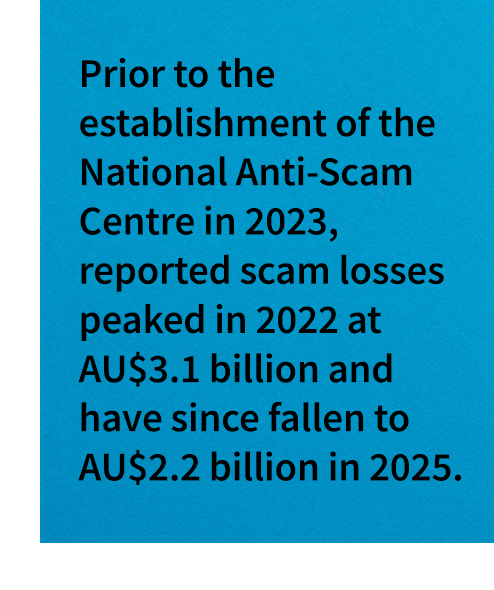 The National Anti Scam Centre’s fusion cell operations have led to the takedown of thousands of scam websites and accounts, and Scamwatch reporting has helped identify and disrupt large scale scam networks more quickly. Prior to the establishment of the National Anti-Scam Centre in 2023, reported scam losses peaked in 2022 at AU$3.1 billion and have since fallen to AU$2.2 billion in 2025. This clearly demonstrates the impact of a unified national strategy that brings together government, financial institutions, telecommunications providers, and digital platforms, with a focus on prevention and consumer education.
The National Anti‑Scam Centre
Australia’s model is built around the National Anti‑Scam Centre (NASC), operated by the Australian Competition and Consumer Commission. The NASC consolidates reporting, intelligence, and disruption efforts across banks, telecoms, digital platforms, and government agencies. Its mandate includes prevention and disruption, community awareness, and victim support.
Fusion Cells and rapid disruption
A distinctive feature of the NASC is its use of Fusion Cells, short term public private task forces that focus on specific scam types. These teams work together to quickly shut down fraudulent websites, accounts, and online tools used by criminals.
Industry codes and technology integration
Australia is developing mandatory industry codes for banks, telecoms, and digital platforms through its Scam Prevention Framework. These codes outline expectations for identity verification, transaction monitoring, scam response processes, and the removal of scam content. Analytics driven detection, cross platform alerts, and automated domain takedowns form a central part of the national strategy.
Public awareness and consumer outreach
The Australian model recognizes that public awareness is essential to reducing victimization. Scamwatch, operated by the NASC, provides alerts, guidance, and trend reporting to the public. This national tool encourages consumers to report suspicious activity and stay informed about emerging scams.
The United States is advancing a multi part strategy to address the growing volume of online scams and cyber enabled fraud. This includes new legislative measures focused on digital platform accountability and a major executive initiative aimed at disrupting transnational criminal networks and strengthening federal coordination.
Targeting deceptive digital advertising through the SCAM Act
The Safeguarding Consumers from Advertising Misconduct Act (SCAM Act), introduced in February 2026, reflects growing concern about fraudulent advertising and scam promotions on digital platforms. The legislation targets deceptive content on social media, search engines, and online marketplaces, including both paid advertisements and sponsored posts. Its goal is to protect consumers from financial harm by ensuring this type of content comes from legitimate, verified sources.
Under the SCAM Act, digital platforms would be required to strengthen advertiser verification processes, validate advertiser identities, maintain records of ad purchasers, and remove fraudulent or misleading ads promptly. The Act also encourages platforms to adopt internal controls that prevent repeat offenders from re entering the advertising ecosystem. To support enforcement, the legislation expands the Federal Trade Commission’s authority to regulate deceptive online advertising and pursue civil penalties against coordinated fraud networks.
State-level legislation
At the state level, Nebraska recently passed legislation updating the state’s Uniform Deceptive Trade Practices Act, making social media platforms responsible for stopping fraudulent ads which target residents. It requires platforms to verify advertisers, maintain fraud‑detection systems, and give users and law enforcement a clear way to report suspicious ads. Once a report is filed, platforms must quickly investigate and, for any ad found to be fraudulent, remove it within five business days. Lawmakers framed this as a way to modernize consumer protection statues and reduce online scams that disproportionately affect older and vulnerable Nebraskans.
A national push to combat cybercrime and transnational scam networks
Complementing the SCAM Act, the United States government introduced a major new initiative in March 2026 through the Combating Cybercrime, Fraud, and Predatory Schemes Against American Citizens Executive Order. This directive recognizes that many large scale scams originate from sophisticated criminal organizations operating abroad and requires a coordinated federal response.
The Executive Order directs federal agencies to strengthen their operational, technical, and diplomatic capabilities to combat cyber enabled fraud, including impersonation scams, phishing operations, ransomware, and large scale online fraud schemes. It prioritizes identifying and dismantling transnational criminal networks, improving intelligence sharing, and enhancing cooperation with international partners.
The order also calls for improved victim support, expanded public alerts, and a government wide action plan to disrupt high impact scam operations.
Public awareness and consumer education
While the SCAM Act focuses on platform accountability and the Executive Order strengthens federal enforcement, consumer education remains a key part of the overall United States approach. The Federal Trade Commission publishes consumer alerts, scam trend reports, and educational materials through programs such as its long running "Pass It On" campaign. The FBI’s Internet Crime Complaint Center (IC3) issues public warnings about emerging online threats, helping consumers stay informed about new scam tactics.
Together, these measures reflect a broad United States strategy that combines legislative action, federal coordination, and public awareness to reduce the impact of online fraud. And while the SCAM Act has not yet been passed into law, it highlights an increasing awareness that scams must be addressed at the source, and that online ads, especially on social media, had become a primary starting point for scams.
The United Kingdom has chosen a rules based approach to combating fraud, particularly authorized push payment fraud in which criminals trick individuals into sending them money. Its model is built around strong regulatory direction and clearly defined responsibilities for payment service providers (PSPs), the third party companies that allow merchants to accept various payment methods.
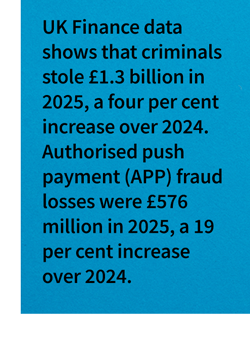
However, this approach has not stemmed the rise of fraud: UK Finance data shows that criminals stole £1.3 billion in 2025, a four per cent increase over 2024. Authorised push payment (APP) fraud losses were £576 million in 2025, a 19 per cent increase over 2024.
 Regulatory direction and oversight
The United Kingdom’s approach is anchored in detailed regulatory guidance from the Payment Systems Regulator (PSR). The PSR sets expectations for how PSPs should prevent and detect fraud, including requirements for data sharing, standardized reporting, and the use of specific customer warning practices.
Defined responsibilities for payment service providers
In practice, these expectations mean PSPs must maintain robust customer authentication processes, monitor transactions for unusual or high risk activity, and share relevant fraud related data with other institutions to support early detection. They are also required to provide clear, timely warnings to customers when a transaction shows indicators of potential fraud. PSPs must participate in sector wide intelligence sharing initiatives and follow standardized reporting requirements so regulators and industry partners have a consistent view of emerging threats.
Cross sector coordination
The United Kingdom has established several bodies to support coordination across sectors. The Joint Fraud Taskforce brings together banks, telecom providers, digital platforms, government, and law enforcement to tackle fraud collectively and is developing a new national fraud strategy. The National Economic Crime Centre oversees strategic efforts to address economic crime, while the Dedicated Card and Payment Crime Unit focuses on specialized investigations.
The United Kingdom has also introduced voluntary charters to strengthen cooperation with major industries. The Online Fraud Charter, signed by large technology companies, commits platforms to faster removal of fraudulent content, improved advertiser checks, and closer collaboration with law enforcement. The Telecommunications Fraud Sector Charter outlines steps for telecom providers to block scam calls and texts, share intelligence, and improve customer warnings.
Public awareness and consumer education
The national Take Five to Stop Fraud campaign helps the public recognize common scam tactics and encourages safer digital behaviour, using behavioural insights to counter psychological techniques often used by fraudsters.
Recent developments
The United Kingdom’s Fraud Strategy 2026–2029 sets out a national plan built around three pillars—Disrupt, Safeguard, and Respond—and includes new investments in AI enabled detection, early intervention tools, and an Online Crime Centre to support large scale disruption of online fraud. However, social media and technology platforms, on which a substantial portion of fraud begins, will still largely operate under voluntary codes. Finally, the Economic Crime and Corporate Transparency Act introduced a new “failure to prevent fraud” offence for large organizations, now entering its first full year of enforcement. This applies to fraud committed by an “associated person” providing services for or on behalf of the organization, such as an employee, agent, or contractor.
Australia, the United States, and the United Kingdom each offer distinct approaches to combating fraud and scams, with only Australia’s model demonstrating an ability to reduce frauds and scams. Australia emphasizes centralized coordination, rapid disruption, and mandatory industry codes; the United States focuses on digital platform accountability and a strengthened national response to cyber enabled crime; and the United Kingdom relies on a structured regulatory model with clearly defined responsibilities for payment service providers and extensive cross sector cooperation.
Australia’s model shows that effective fraud prevention requires a mix of regulation, cross-sector collaboration, technology enabled detection, and informed consumers. Learning from the experience of other international frameworks can help shape Canada’s ongoing efforts to strengthen fraud prevention and protect the public, while respecting privacy obligations. At the same time, it can also help efforts to educate Canadians that the scale, sophistication, and global nature of fraud requires a coordinated, national strategy across the public and private sectors.